Tuesday, June 21, 2011

Patterns: Better Homes and Gardens Pouf


Two lucky BHG subscribers will WIN the one of the ottomans in the photo above. Both are made by Lara Newsom of Handmade Pretties.

Open the latest copy of Better Homes and Gardens and you will find a stitched yellow burlap ottoman made by Handmade Pretties as a set piece. After creating the ottoman as a mere photo prop, the editors at BHG asked me to create a pattern that would be available for free online (all you have to do is register with BHG to download the pattern). For $50 or less, you can create one of your own.

In addition to generating all of the digital pattern files and written instructions, I spent a day working with Amy Panos of BHG on the set of the photo shoot. Two lucky BHG subscribers will WIN the two ottomans in the photo above.

Saturday, June 18, 2011

Favorite Songs: Buoy - The Nightgowns


I love the lyrics in this song. It's like coming out of a fog and finding yourself in the bright sunshine. (or like coming out of the basement and finally getting to go to bed...)

Friday, June 17, 2011

Magazine Feature: Do It Yourself Magazine Spring 2011


Title Page for the Story. I created the dyed and starched candy dishes.

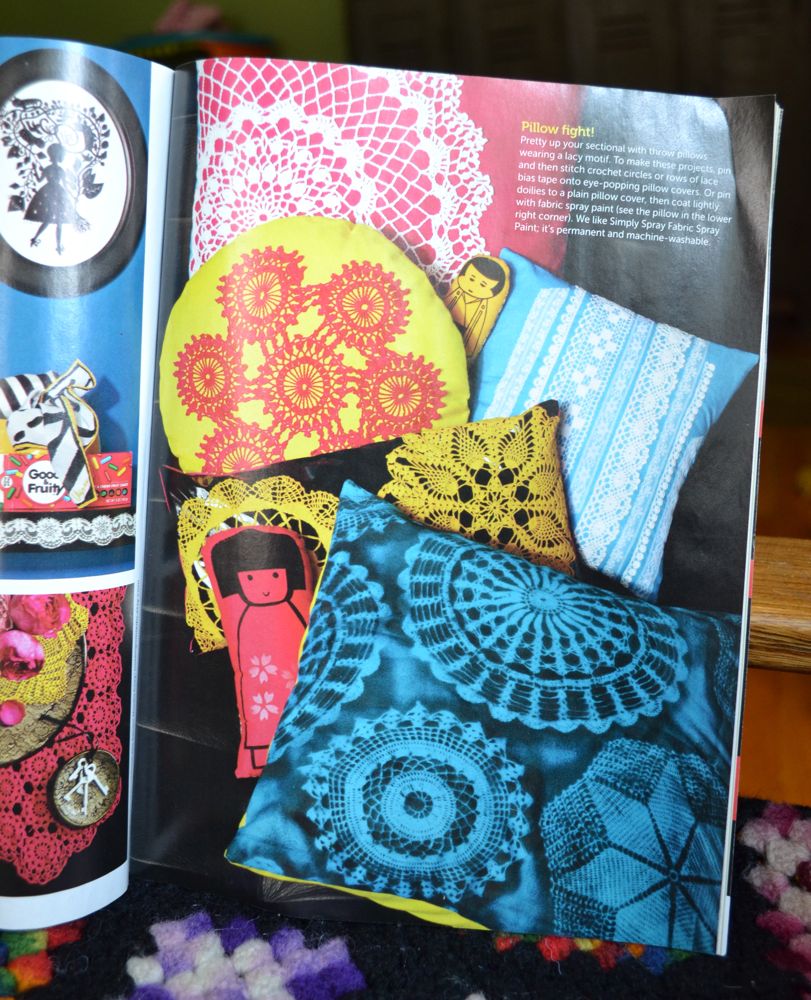
I worked with Jessica Thomas on Eye Candy for the Spring 2011 issue of Do It Yourself Magazine. I spent a good month collecting doilies and lace, dying doilies and lace, painting doilies and lace, and finally sewing doilies and lace. I created the stiffened doily dishes using watered down white glue and a final coat of shellac. I used a similar technique to adhere the lace to votives and a large mason jar vase. I also created the five lace and doily embellished pillows on page 83. The teal pillow in the front simply used doilies as stencils for spray paint. The others featured doilies and lace sewn to the surface of the pillow.


A lovely stack of pillows. I designed and produced all five lace and doily pillows.

A shot of the votives and the mason jar vase.

Wednesday, June 08, 2011

Magazine Feature: Giant Monkey Block Pattern


The finished dice right before I dropped it off at Meredith.

The Winter 2010 issue of Quilts and More (published by Meredith), features a pattern that I created for an over-sized monkey block. I generated all of the digital files for the patterns and wrote the instructions. Meredith shot all of the amazing photos with the baby (my babies are big girls now). Eventually, I will offer this pattern for sale on my etsy site.


The magazine cover

Title Page of the pattern


Tuesday, June 07, 2011

Magazine Feature: Do It Yourself Magazine Winter 2010


The title page of the story. I hand cut and stitched the felt artwork for this page.

"We Love Felt" is published in the Winter 2010 issue of Do It Yourself magazine (pg 76). I worked on this piece with Jessica Thomas to create the backdrops and cube props. I created the title page "We Love Felt" piece. Additionally, one of my felted wool brooches is featured on page 79.


I created the felt covered block set pieces for this shoot.


More of the felt block in action.


My brooch is the spiky red orange flower in the foreground.

Tuesday, March 29, 2011

Handmade Pretties in Pottery Barn


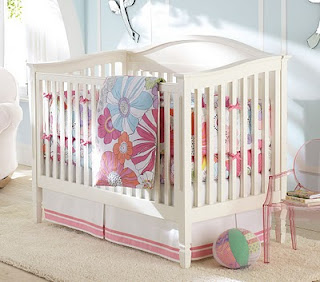
This photo belongs to Pottery Barn Copyright 2011, Williams-Sonoma, Inc. All Rights Reserved.
The ball in this photo is made by
Handmade Pretties.


You might open up the latest Pottery Barn catalog and notice a pink and green sweater ball next to the crib in the photo of the Wildflowers bedding set. Yes. It is a Handmade Pretties ball. I think I still have bits of those sweaters in the bin ready to be sewn!

Good news! I offer sweater balls in a rainbow of colors. You can either choose your color palette to match your decor (doesn't the ball look GREAT in the photo!) or order one of my very popular rainbow sweater balls. These balls can also be personalized and make a really great gift.

I also offer sweater balls in a fun mini size.

Wednesday, March 23, 2011

Do It Yourself: Cardboard City!


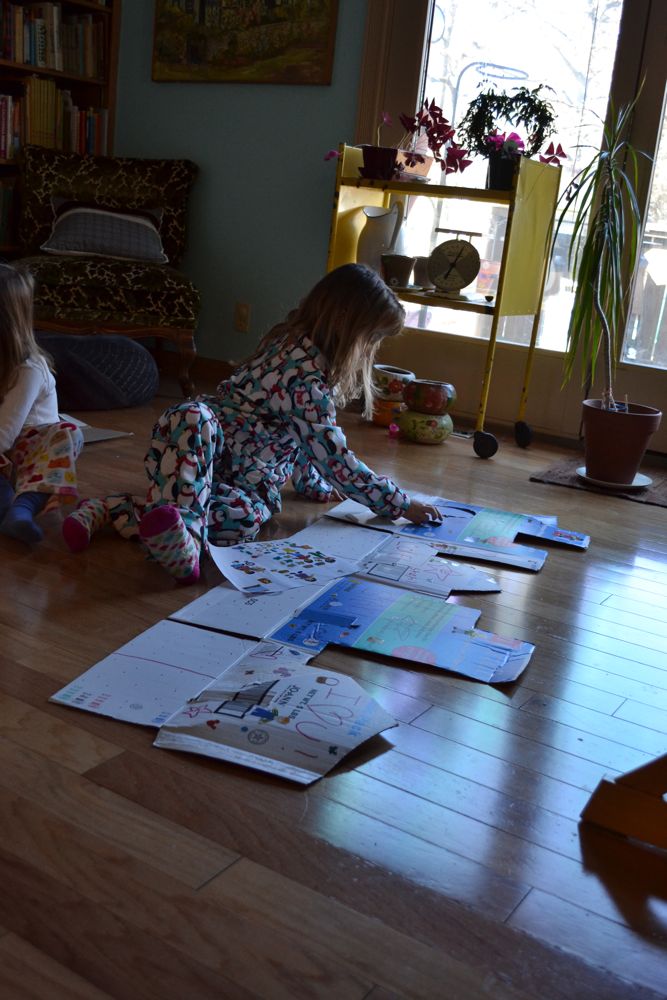
Beatrice playing with the finished product. They also had fun making a circle to keep out tornadoes (yes, they are true midwestern girls).

How many times have you heard "Mom! When are we going to do something fun?" I hear this about ten times a day (ironically it is often on the way home from the zoo or some other epic adventure.) Over Spring Break, our wallets demanded that we find some fun stuff to do at home. So we created cardboard city scapes.

Handmade Pretties uses a lot of 5 pound stuffing boxes, so we chose these as our starting box. Any large box will work.

The first step is to open up the box. Open the flaps on the top and the bottom, then carefully break the seam along the side of the box.

Next, draw your city scape on the main portion of the box (you will be cutting off the top flaps and using the bottom flaps as the supports to make the city stand). Using scissors or a serrated knife, cut out your city. I prefer the serrated knife, since it can be used like a saw, but I have been known to cut deeply into my finger tips while doing this, so be very careful.

Now, draw some doors that sit right along the crease between the main body of the box and the bottom flaps (this way the doors will be at ground level). When you cut out the doors, be sure to leave one side attached if you want the door to open and close.


Beatrice carefully choosing her stickers.

The final step is to give the city scape to your children to decorate. My kids used markers and stickers, but crayons, stamps, paint, and/or glitter glue can also be used.


Sylvia putting on the finishing touches.

Once the kids are done decorating, set up your city and play! The city scapes are a fun addition to blocks and cars, and can be easily folded flat to store. Once the kids are done with them, don't forget to recycle the cardboard!

Monday, March 07, 2011

Do It Yourself: Little Red Riding Hood Game


We used little wooden peg dolls that we found at Michaels for the game pieces.

Several years ago for Christmas, we bought the girls a small collection of blank books and puzzles from Bare Books. We also bought a blank game board with a spinner and a set of cards. We FINALLY decided it was time to make our first game.

First I showed the girls the game board, and we started talking about what kind of game they would like to play. We talked about which games we already have and how those games are played. They really like Candy Land (and candy...) so they wanted something with a path. They kicked around ideas including unicorns, candy, Little Red Riding Hood, and unicorns dressed up like little red riding hood looking for candy. Looking for a theme that had a story line they were both familiar with and that wasn't overly complex, we opted to make a Little Red Riding Hood game.

Getting Started:
Once we got our theme in mind, we started by deciding how the players would move through the game. They both like spinners more than dice, so we used the blank spinner that we got with the game board. It was divided into six sections four sections strictly for movement (go forward 1,2,3, or 4 spaces), one penalty type section (the wolf), and the bonus section (cookies and muffins). The girls also enjoy Chutes and Ladders (ok they like the ladder part better than the chute part) so they wanted to include "wolf paths" so that little red could cut through the forest and get to Grandma's house faster. To add an extra educational aspect to the game, we made the blank cards into "wolf cards". The wolf cards feature simple math problems, spelling, story completion (What big eyes you have the better to ________ you with"), and a handful of lose a turn cards. When the player spins a wolf, they have to answer a wolf card. If they get the answer correct, they get to move one space if not they lose a turn. Also, if the player lands on the space that leads to the wolf path, they can draw a wolf card. If they answer correctly, they get to cross the path. If the cookie/muffin section of the spinner is spun, the player gets to advance to the next cookie or muffin space on the board.

Planning out the game ahead of time will make a big difference in how it ends up.


You can see some of our preliminary plans on the drawings next to the game.

Get to Work:

My girls are six and three (almost four), so I needed to give them simple tasks that would make them feel like they were really contributing to the game. Sylvia (my six year old) is very artistic, so after I drew in the basic path, her job was to draw grandma's house and all of the background decorations. (She chose to make it Grandpa's house, apparently grandma was at the grocery store...) Beatrice helped me decorate the wolf cards and drew little red's house at the start. Sylvia also worked on the spinner. We used markers and watercolors to color in the game board. Both girls are pretty good at painting, so all three of us painted in the background of the board using watercolors.

The final missing piece were the player pieces. Of course the girls wanted them to look like Little Red Riding Hood, so we took a break and went to Michael's to find some blank peg dolls. I cut little red pieces of fabric for hoods and to distinguish players we used different colors of yarn to tie the hoods. I drew the faces with a sharpie.

While at Michael's we also purchased a gift box large enough to hold the game. I taped paper dividers inside the box to hold the parts, and the girls beautified the outside.


This is a 9.5" x 12" gift box that I taped paper dividers into to house our game. We also considered a shallow plastic bin, but I am cheap, and the 69¢ box won.


Working on the game board. Sylvia is finishing up Grandpa's House, Bea is finishing up Little Red's House.


My little game elf hard at work.


After TWO HOURS of solid work (I can't believe they stayed with me the WHOLE time!) the game is ready to play!

The whole process took us over two hours to complete. Sylvia was completely on board the entire time, while Beatrice took a snack break and a drawing break. This project (or a similar one) would be a great activity for kids 6-10. There are a few things I would change about the game, for example, there are not enough penalty spots and there is no way for a player to move backwards, so it is pretty easy to play. As a parent, I like that the game can end pretty fast, but the kids would probably get a good lesson from having to move backwards. Overall, I am happy with the game. The girls definitely love it, since we play it at least once a day...

Friday, February 11, 2011

Do It Yourself: Marshmallow and Toothpick Erector Set


Beatrice with our creation.

It's cold. It's really cold, and Beatrice is bored. Really bored. While we could play another round of Tea Party the game, today I decided to try something a little different. We built a structure out of marshmallows and toothpicks.

Here is what you need to try it too:
One bag of mini marshmallows
AT LEAST 2 -250 count boxes of toothpicks (we use the round ones because my kids are used to being around pointy things, but flat would work too)

Start simply by showing your child how to stick the toothpicks into the marshmallows. Explore basic shapes like barbells, wands, triangles, squares, etc. Move on to more complex shapes like cubes etc. Beatrice and I worked together on our structure. We started by building onto our simple shapes as the structure grew, we talked about what shapes were the strongest (triangles) and how to build support to hold up the structure. As one piece sagged, we built others to hold it up. We played for almost 45 minutes.

Beatrice is 3 and a half years old, and she was able to add to the structure and support her own additions. I helped her if she asked and worked on the "groundwork" to make sure she had a good time building. The structure will continually morph as you build. Parts will sag down as you prop up other parts. Pyramidal supports will hold up sagging sections while emphasizing the importance of supporting structures. See the photos for examples.

Building with blocks, legos, tinker toys or even marshmallows and toothpicks teaches very important spatial and mathematical concepts to your child and is rewarding and fun!


Close-Up

The Masterpiece!

Wednesday, January 26, 2011

Do It Yourself: No Sew Arm Warmers A.K.A. Stop Mitten Gap!


Sylvia modeling the finished goods

This one is for all those kids out there with cold wrists!

If you have spent any amount of time playing in the snow, you have probably experienced the chilling shock of snow on bare wrists. As a child, it was my mission in winter to perfect the art of carefully tucking my mittens into my coat sleeves, but one swift move in a snow ball fight would undo all of my hard work. Now that I have my own children, I want to spare them the agony, so I made them a few pairs of fleece arm warmers. They work like a charm.

Yesterday, an old friend of mine suggested I create mittens to sell that are longer so that her own daughter can enjoy hours of fun in the snow. While I haven't had the time to work out the pattern, I have come up with a great solution for all the parents out there who don't have time to sew.

Here is what you will need:

1 pair of children's knee socks - holes in the toes do not matter so feel free to recycle an old pair
1 pair of scissors


1. lay the sock flat, and cut across the foot of the sock and the edge of the heel. Be sure to leave a little fabric so there is a piece to go between the fingers and the thumb to help keep the arm warmer in place.


2. Insert the arm of a child. Beatrice is modeling the proper technique for applying this product.


3. Put the glove on over the arm warmer and then the coat. The arm warmer will help protect your child's wrist, making snow play far more exciting!

This pattern can be used for adults as well! Involve your kids by allowing them to select which sock they will use. Older children (6+) should be able to make the cuts as well. To prevent serious fraying, select a sock that is mostly cotton or wooly, avoid high nylon content (which wouldn't be all that warm anyway). Hand wash when needed.

Thursday, January 13, 2011

Etsy Favorites: What Santa Brought

It is one thing to believe in buying handmade, it is another to actually do so. This year I made it my goal to get at least 75% of our presents handmade. The other 25% were books, a couple of movies, and a few games. My customers are so good to me, I try to spread the love out as much as I can. Here are some of the great items we scored on Etsy this year!


You may see Scott out wearing this fantastic Tshirt. It is from Billyyy.


The girls got a chicken dinner, pumpkin pie, AND witches brew from Mudpie Kids.


This little guy lives on Sylvia's bed now. We bought it from Cuore.


We got one of each for the girls. Purchased from Sweet Bonny.


Stuffed this baby in Scott's stocking. Bought it from Nowvember, home of the amazing rainbow vomiting cat journals.


Buck Yeah poster for the man in my life from Mixed Species. LOVE this shop.


Hers and hers superhero capes from Baby Pop. Now in addition to playing Wild West they can play Wild West plus Superheros.


I bought two of these cuties for my girls from Tokyo Inspired. They arrived gift wrapped in Japanese paper which helped proliferate the whole Santa thing.


Purchased from Timberps for my step-brother. He predicts this will add a whole new level to the "wood" jokes in shop class.


Purchased from Arizona Dreams for Sylvia after being told that she would no longer have bad dreams if only we'd buy her a dreamcatcher. These were the nicest ones we saw on Etsy.

Tuesday, January 11, 2011

I'm Helpful: How to Carry More Than One Coat

I love winter. I really do. Without it, I feel lost in a perpetual time loop. I do not, however, like the crap that goes along with winter, like coats. I can deal with my own coat, but there is nothing more frustrating than being out with a couple of kids who refuse to carry their own coats. I have been tempted to leave the coats where the kids drop them, walk off and say something like "I hope the kid who finds your coat likes it," and "Boy are you going to be cold when we go back outside," but those little turds will just walk away, leaving a perfectly good winter coat to be swept up by the world. So inevitably, I end up carrying three winter coats (as we are beyond the age of the stroller). Not only does this make my arms tired, but it makes me super grouchy.

The other day, we had to kill a few hours at the mall while our brakes were being worked on. The thought of carrying three coats, my purse, and all the other little stupid things the kids hand me was overwhelming. So I devised a way to turn our coats into a sling bag. The integral part of this device is a scarf. I prefer an adult length scarf, but a kid scarf will do in a pinch.


1. starting with the biggest coat, place the coats inside each other (like a russian doll) stuff the sleeves inside one another.


2. Thread the scarf through the sleeves so the ends are sticking out of either sleeve.

3. Zip or button all of the coats.


4. Tie the ends of the scarf together (I like a square knot) to create a strap.


5. Sling the coats over your shoulder and carry on!

Sunday, October 31, 2010

Recipes: Homemade Pumpkin Muffins


It's Halloween! And what would be more suitable than fresh baked pumpkin muffins. I used the flesh of one of the Vif D'Etampes Pumpkins that we grew in our garden this year. Fresh made pumpkin puree lacks the tinny taste of canned pumpkin and allows you to use the flesh of the many wonderful varieties of pumpkins available on the market.

Dry ingredients:
2 cups whole wheat pastry flour
1 tablespoon baking powder
1/2 teaspoon salt
2 teaspoons pumpkin pie spice
1/3 cup flax seeds
1/3 cup pepitas or sunflower seeds (unsalted)

Wet Ingredients:
2 eggs
1 cups milk
1/2 cup (1 stick) melted butter
1 cup pumpkin puree (canned or *fresh made)
2/3 cups packed brown sugar
1 teaspoon vanilla

Preheat oven to 400 degrees and line muffin tins (makes about 18-24 regular sized muffins)

Mix together all of the dry ingredients in a medium sized bowl and set aside. In a medium sided bowl combine all wet ingredients. Combine the wet and dry ingredients until just mixed (do not overmix). Fill muffin tins about 2/3 full and bake for about 16-18 minutes until a knife comes out clean when inserted in the middle. Cool and enjoy with fresh butter.

* Fresh made pumpkin puree
Select a pie pumpkin, vif d'etampes, or long island cheese pumpkin. I prefer the long island cheese pumpkins. These are the pumpkins that are the same color as a butternut squash on the outside and yield a sweet creamy bright orange flesh. Cut in half and scoop out seeds. Place upside down on a baking sheet (be sure to use one with sides as cooking pumpkin WILL release water). Bake for 40-55 minutes at 375 degrees (larger pumpkins take longer than smaller ones). Your pumpkin will be done when the dome collapses. Remove from the oven and allow to cool completely. Carefully remove the flesh from the outer shell. Mash the flesh with a potato ricer (for muffins or breads) or puree (for pies and custards) in a food processor. You will likely have ALOT of pumpkin puree, the excess can be frozen and stored for up to a year. I portion out the frozen puree into 2 cups portions (this is how much puree is called for in my pie recipe).

Thursday, September 23, 2010

In the Studio: Homemade Dust Filter


My super fantastic dust collector.

If you've ever used a serger, you know that it can generate some serious lint. With what I do, the lint can get overwhelming both physically and emotionally. I worry what all those little fibers are doing to my body and our home. My first step to battle the lint was to purchase a canister vac with a hose so I can periodically suck up the lint. This did help, however I knew I could do better.

I often wear a dust mask when I lay out skirts (just moving cut sweaters is linty) and when I sew. I found that traditional dust mask work well, but they tend to irritate my face, so I fashioned a cowboy style dust mask from several layers of fleece. Between this and the constant vacuuming, the air in my studio has improved, but constantly wearing a dust mask makes my work feel like hard work, so I began to look for an alternative.


Here I am sewing with my dust mask and headphones.

I considered buying an expensive air filter but worried that the amount of lint I generate would instantly destroy it. Instead I rigged up my own air filter using a recycled mail box, a small fan, and several layers of high lift quilt batting.

Materials:
small circular fan (mine is about 10" in diameter)
box (I recycled a 12 X 12 X 8 priority mail box, just make sure your fan barely fits inside)
2 scrap pieces of high loft polyester quilt batting the same size as your box
packing tape
box cutter or serrated bread knife
staples
ruler

1. tape the box on one side be sure to tape on the edges for all four flaps.

2. Cut a circle the approximate size of your fan using the knife (i prefer a serrated bread knife b/c it works like a saw) tape the flaps around the circle to secure.

3. on the side of your box cut a rectangular opening on three sides to allow access to your fan to turn on and off. Leave the flap attached to act like a door.


The access door for fan controls.


4. Put the fan inside the box and tape it to the bottom of the box. Pull the cord through one of the corners between the flaps.

4. On the untaped side of the box, cut off the top flap. For the three remaining flaps, measure in 1" and on the inside of the flap using the dull side of the knife (or a pen) score a line to allow easy folding.

5. fold the flaps in and then measure out 1" and cut off the remainder of the flap. fold in the flaps and tape. This will create the channel for your filter to sit.


This shot shows the handle attachment and the filter slot.

6. using 1" scraps of cardboard, staple the two layers of quilt batting to the cardboard on all four sides. I taped the corners of min to be sure they stayed together (the staples do not like to go through two layers of cardboard).


The filter sitting outside of the slot.


7. put your filter in and secure with a few straight pins (if not when you turn on your fan the air pressure will suck the filter inside the box).


This shows the filter being inserted into the slot. I taped the top of the filter and stuck a few straight pins through the cardboard to hold it in place when the fan is on.

8. Using a 3-4" scrap of cardboard, create the handle by folding it in thirds. About 1 " up from both ends of the handle cut through the outside folds and spread out to create feet. Tape the middle section around to make a smooth handle and securely tape the to the top of the box.

I have my filter placed directly behind my serger at tableheight and it seems to do a really great job pulling the dust away from me. I can actually see the dust collecting on the fiberfill. When it gets full, I will try vacuuming it first and if that fails, I'll make a new filter.